

Where were we before we were born? Where do we go when we die?
Beliefs vary widely across cultures, but these questions remain familiar. Among the Ewe of West Africa, traditional accounts offer a way of understanding existence that extends beyond the years we spend among the living.
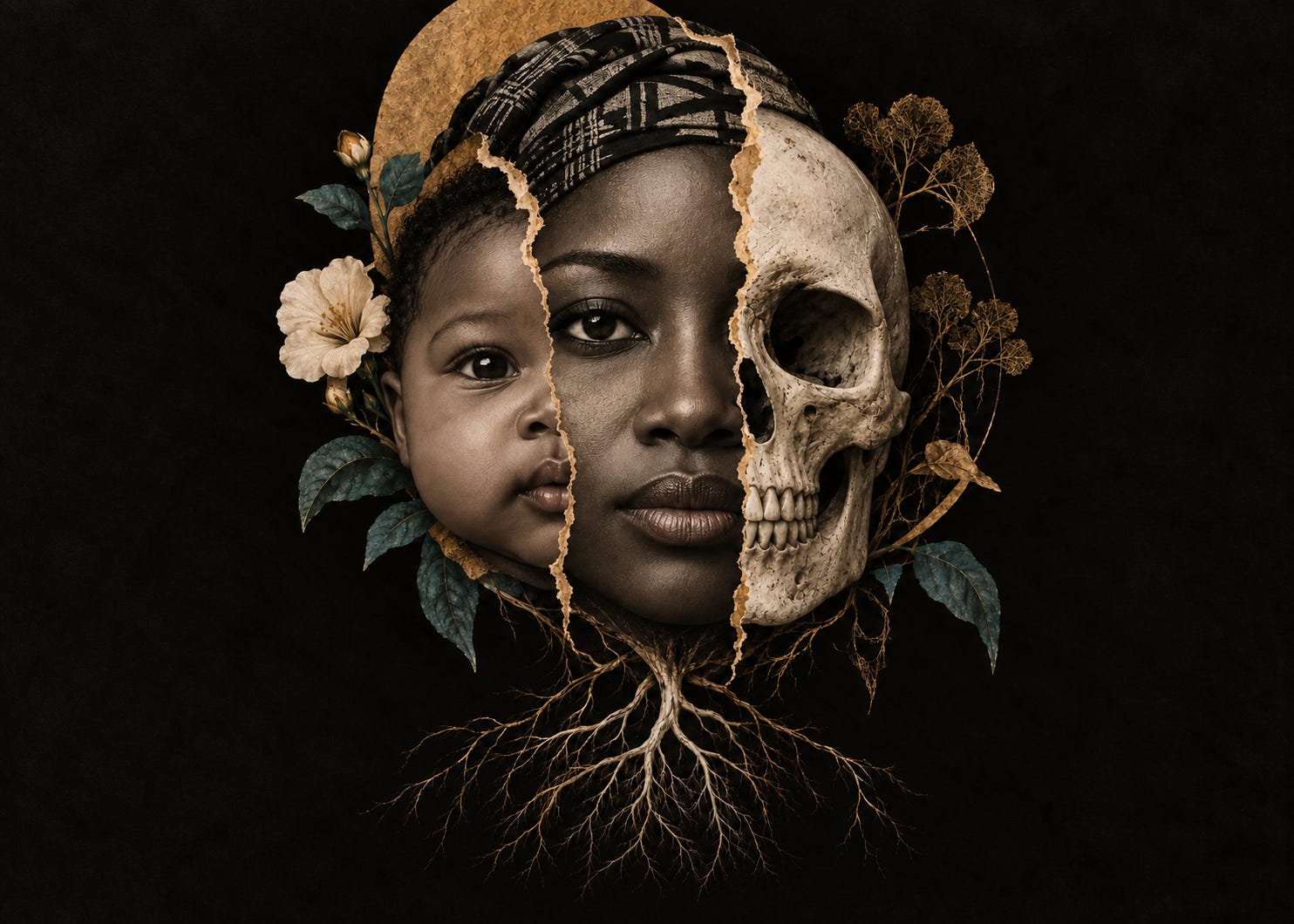
In the account explored here, birth is an arrival, death begins a journey, and life belongs to a cycle connecting three worlds.
This article draws primarily on the Ewe-language writings of Linus Gbekɔbu. It presents one account of these traditions, whose details may vary between Ewe communities. Ewe spellings have been retained to preserve the terms through which these ideas are expressed.
Three worlds, one cycle
This understanding of existence distinguishes three realms: Bome, the world before birth; Kodzogbe, the world of the living; and Tsiɛƒe, the world of the dead.
We come from Bome, spend our earthly lives in Kodzogbe, and journey towards Tsiɛƒe after death. Each realm has its place in the passage of a human life.
Bome: where life begins
Before entering the world of the living, we belong to Bome. The word also refers to a field or garden in Ewe. The image is suggestive: a place where seemingly lifeless seeds awaken, take root, and produce new life. A garden thus becomes a way of imagining the source of human existence.
This realm has other names, including Dzɔƒe, the source; Ƒeme, home; and Seƒe, the home of Se, understood here as a divine presence. Presiding over it is Bomenɔ, the mother of Bome.
Bomenɔ: the mother of souls
In this account, the source of life is entrusted to a maternal figure. As women bring life into the human world, so a mother presides over the realm from which human beings emerge.
Bomenɔ is also known as Krawonɔ, the mother of souls, and ŋolimenɔ, the mother of the departed. The latter name points towards the possibility of return: those who have died may come back.
Before entering earthly life, human beings make a vow to this mother of souls. An entity called Gbetsi, also known as ŋolimetasi, the aunt of the departed, witnesses it.
Some promise to live long and happy lives; others undertake shorter journeys. In this belief, the life that unfolds after birth is connected to a commitment made before it.
This understanding informs a number of traditional rites performed when a child is born.
Aklama: the keeper of the promise
The vow is entrusted to Aklama, a guardian charged with ensuring its fulfilment. Aklama also accompanies the person about to be born into Kodzogbe, the earthly world.
Aklama is also called Dzɔgbe, which can be translated literally as “day of birth.” The term appears in everyday expressions: dzɔgbenyui conveys happiness or good fortune, while dzɔgbevɔe expresses misfortune.
Within this understanding, fortune and adversity are connected to the working of a person’s Aklama and the fulfilment of the original vow. In everyday usage, this notion may also overlap with that of Mawu, the supreme God.
Tsiɛƒe: the journey after death
After death, the departed travel to Tsiɛƒe, the home or world of spirits. Tsiɛ means spirit. Another name for this realm is Tɔgbuiwode, the land of the forefathers.
The dead may be described as Ame yinugbe, someone who has gone on a journey. That journey requires preparation. Objects are therefore placed with the deceased for use along the way. Among the passages ahead is the crossing of Kutɔnu, the river of the dead, accompanied by Kutsiami.
Death does not, however, guarantee admission to the community of ancestors. According to this account, a person who lived badly or was not properly buried may be refused entry. Unable to join the ancestors, the spirit returns in anger to haunt the living.
The cycle is interrupted. Without reaching Tsiɛƒe, the departed cannot proceed to Bome and eventually return to the world of the living through birth.
A passage rather than an ending
These beliefs connect birth, conduct, burial, and remembrance. The way a person enters life, lives it, and leaves it forms part of a larger journey.
Versions differ within Ewe communities, and related ideas appear among other peoples in the region and beyond. This account nevertheless offers a coherent response to two enduring questions.
We arrive from somewhere. We depart towards somewhere. And between those passages lies the life we share with one another.
Espérons!